Water heaters · tank and tankless
No hot water? Let’s find out why first.
We repair what’s worth repairing, replace what isn’t, and explain the difference in plain words before any work starts.
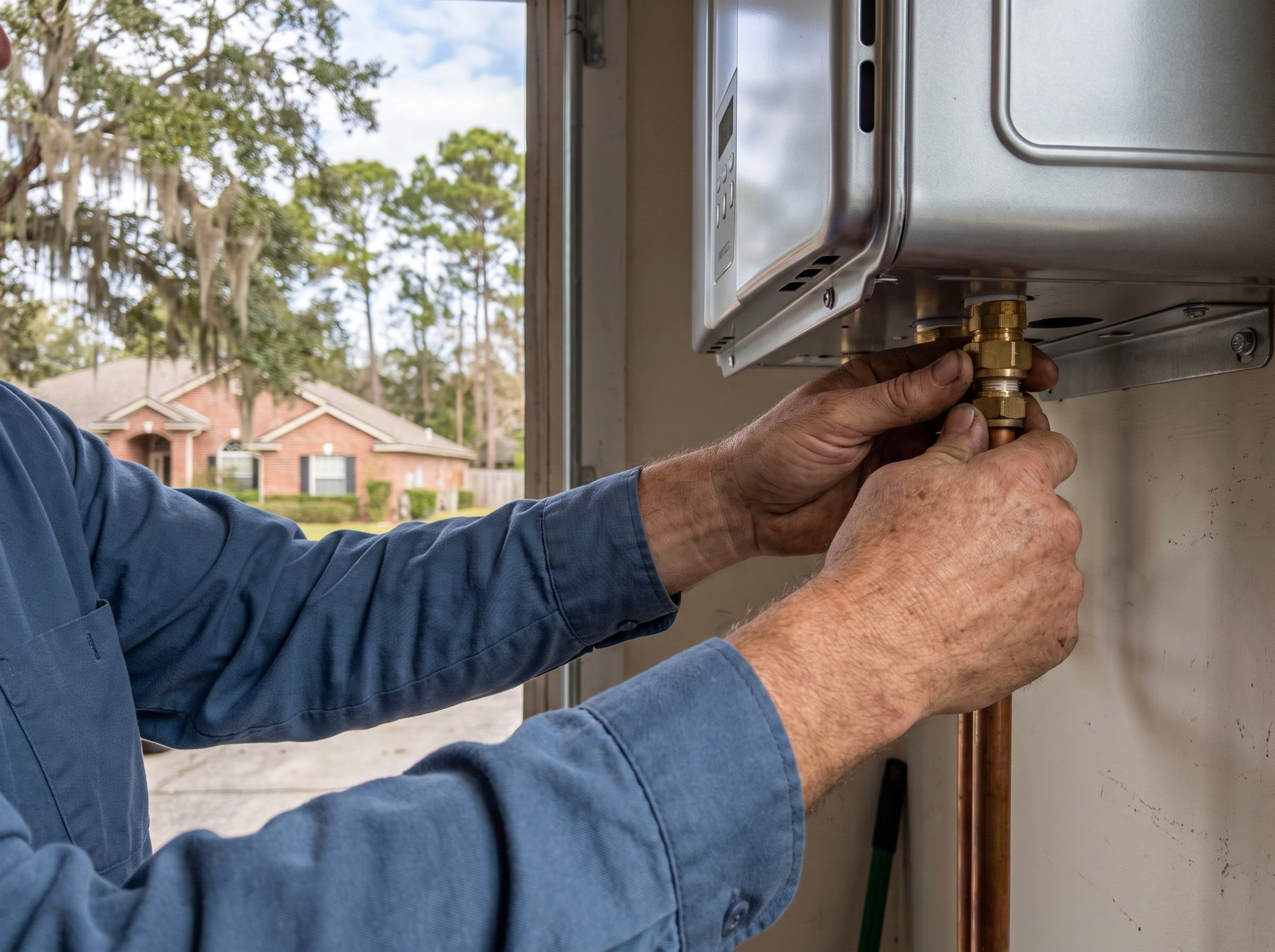
The problem
Water heaters usually warn you before they fail.
These are the signs we hear about most, and what they often mean.
- 01 No hot water, or it runs out fast
- Often a failed element or thermostat (electric), a pilot, igniter or gas-valve problem (gas), or sediment taking up room in the tank.
- 02 Rusty, cloudy or smelly hot water
- Can point to a worn-out anode rod or corrosion inside the tank.
- 03 Popping or rumbling sounds
- Usually sediment on the bottom of the tank. Flushing helps if it’s caught early.
- 04 Water around the base
- Could be a fitting or the relief valve, which can be fixed. A leak from the tank itself means replacement.
What we do
A water heater visit, step by step.
Check the basics first
Power or gas supply, the thermostat setting, the pilot or igniter. Sometimes it really is that simple, and we’ll tell you so.
Test the parts that wear out
Elements, thermostats, the gas valve, the anode rod and the temperature and pressure relief valve.
Give you a straight answer
Repair or replace, with the reasons and the price for each. If a repair makes sense, we say so.
Install it properly
If you replace, we fit the new heater to code, test it with you, and haul the old one away.
Tank or tankless
Two good options, for different homes.
General information to help you think it through. Real numbers depend on the model, your home and how your family uses hot water.
Option A
Tank
Stores hot water, ready when you need it. Simplest and lowest-cost to replace like for like.
Option B
Tankless
Heats on demand, never “runs out”, saves space. Costs more to install, lasts longer.
| Topic | Tank | Tankless |
|---|---|---|
| How it heats | Keeps a tank of water (often 40–50 gallons) hot all the time. | Heats water only when a tap is on. No stored water. |
| Hot water supply | Plenty until the tank runs out, then it needs time to recover. | Doesn’t run out, but has a flow limit, so several showers at once can be too much for one unit. |
| Expected life | The U.S. Department of Energy puts typical tank life at about 10–15 years. | The Department of Energy puts typical tankless life at about 20 years. |
| Upfront cost | Lower. A like-for-like swap is usually the simplest job. | Higher. Switching can need a bigger gas line, new venting or electrical upgrades. |
| Running cost | Loses some heat while the water sits in the tank. | No standby heat loss, so it usually uses less energy. |
| Space | Needs floor space in a garage, closet or attic. | Compact and wall-mounted. |
| Upkeep | Flush the tank and check the anode rod from time to time. | Descale periodically, especially with hard water. |
Life expectancy: U.S. Department of Energy, Energy Saver, “Which Water Heater Is Right for You?”
Not sure yet?
Repair or replace? Four quick questions.
The same rules of thumb we’d use on the phone, in plain language.
0 of 4 answered
Answer the four questions to see a suggestion.
Rules of thumb
| Water pooling under the tank | Call now. A leaking tank can’t be repaired, so it will need replacing. |
|---|---|
| Tank over 10 years old with rust or repeated problems | Worth getting a replacement quote. |
| Younger heater, a part has failed | Probably worth repairing (elements, thermostats, valves). |
| Tankless unit | Usually worth servicing or repairing; they often last around 20 years. |
General guidance, not a quote or diagnosis. A plumber confirms it on site.
Questions
Water heater FAQ
Should I repair or replace my water heater?
It depends on the heater’s age, what failed, and whether the tank itself is leaking. A failed element or thermostat on a younger heater is usually worth repairing. A leaking tank isn’t repairable. We’ll show you what we found and price both options so you can decide.
Is tankless worth it?
For some homes, yes: endless hot water, a smaller footprint and lower standby energy loss. But the upfront cost is higher and switching can mean gas, venting or electrical changes. If your current tank works well, there’s no rush. We’ll look at your usage and your home before recommending either one.
How long does a replacement take?
A like-for-like tank swap is often done the same day. Switching from tank to tankless takes longer because of the extra gas, venting or electrical work. You’ll get a time estimate before we start.
What should I do if my water heater is leaking?
Turn off the cold-water supply valve on top of the heater, then turn off the power (electric) or set the gas valve to “off” or “pilot”. If water is spreading, call us, day or night.
Do you take the old heater away?
Yes. The old unit leaves with us, and we clean up the area before we go.
Ready when you are
Ready to sort out your hot water?
Book a time window that suits you. We’ll explain the likely causes on the phone and confirm the visit.
Planning a bigger job? Request an estimateA plumber answers 24/7
- Monday – Friday
- 7am – 6pm
- Saturday
- 8am – 2pm
- Emergencies
- 24/7, every day